
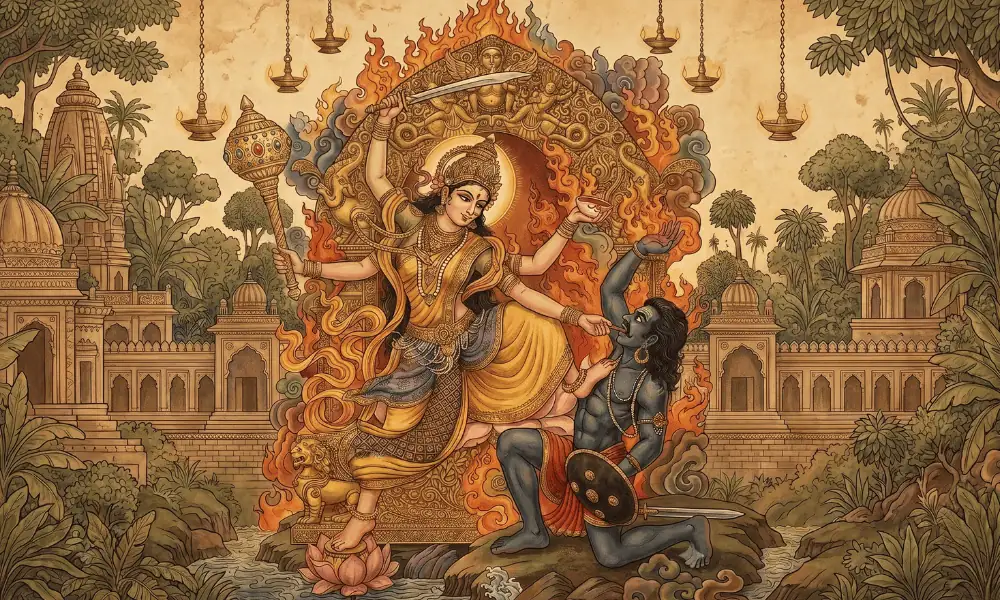
The Mahavidyas, also known as the Dashamahavidyas (दशमहाविद्या) or Das Mahavidyas or Ten Mahavidyas, are a group of ten powerful manifestations of the Divine Mother in Shakta Hindu traditions. The Sanskrit term Mahavidya is commonly understood as “Great Wisdom,” with maha meaning great and vidya meaning knowledge or wisdom.
The ten Mahavidyas represent different dimensions of Shakti, the divine feminine power. Together, they encompass a remarkably broad range of spiritual symbolism—from creation, knowledge and prosperity to transformation, time, dissolution and liberation.
The ten are traditionally identified as:
- Maa Kali
- Maa Tara
- Maa Tripura Sundari
- Maa Bhuvaneshwari
- Maa Bhairavi
- Maa Chhinnamasta
- Maa Dhumavati
- Maa Baglamukhi
- Maa Matangi
- Maa Kamala
Although they are worshipped as distinct forms, Shakta traditions understand them within the larger framework of the Divine Feminine. Academic studies of Hindu goddess traditions also describe the Mahavidyas as a group of ten “Great Wisdom Goddesses” or “Great Manifestations,” while noting that their interpretation and worship can vary between traditions and regions.
What Are the Mahavidyas?
The Mahavidyas are ten forms of the Divine Mother associated with different aspects of spiritual knowledge and Shakti.
The word Vidya means knowledge, wisdom or sacred learning. Therefore, Mahavidya can be understood as Great Wisdom.
Rather than viewing the ten goddesses as completely separate divine beings, many Shakta traditions understand them as different expressions of one supreme feminine reality.
This idea is important because the Mahavidya tradition does not present the Divine Feminine in only one form.
The Goddess can appear as:
- the fierce power of time,
- the compassionate mother,
- the embodiment of beauty,
- the power of speech,
- the source of prosperity,
- the force that removes obstacles,
- the wisdom associated with difficult experiences,
- and the power that leads toward spiritual liberation.
A scholarly discussion of Hindu goddess traditions notes that the Mahavidyas invariably include Kali among the ten and that, in some contexts, Kali is treated as the primary or originating goddess from whom the others emerge.
The Story Behind the Ten Mahavidyas
One of the best-known traditional narratives connecting the ten Mahavidyas involves Goddess Sati and Lord Shiva.
According to a popular account, Sati wished to attend the great yajna organized by her father, King Daksha. Shiva, however, did not want her to go because of the disrespect Daksha had shown toward him.
When Sati insisted on going, Shiva attempted to prevent her.
In response, Sati manifested herself in ten powerful forms surrounding Shiva. These ten manifestations became associated with the Dashamahavidyas.
The story is traditionally understood not merely as a dramatic mythological event but as a teaching about the many dimensions of Shakti.
The Divine Mother cannot be limited to one appearance or one quality.
She can be peaceful or fierce, nurturing or transformative, beautiful or terrifying, depending on the aspect of existence being represented.
Different textual and regional traditions present Mahavidya narratives and iconography differently, so individual details should not always be treated as a single universally standardized account.
The 10 Mahavidyas and Their Significance
1. Maa Kali – The Power of Time and Transformation
Maa Kali is traditionally regarded as the first of the ten Mahavidyas.
Her name is associated with Kala, meaning time, and Kali is therefore strongly connected with time, transformation, dissolution and the destruction of limitations.
Kali is commonly depicted with a dark or black complexion, loose hair and a fierce appearance. Her imagery is intentionally powerful and can include symbols associated with death and impermanence.
These images are not simply intended to represent destruction in a negative sense.
They can symbolize the truth that everything within the material world is subject to change.
Kali therefore represents the power that removes attachment to what is temporary.
Spiritual symbolism of Maa Kali
Kali is traditionally associated with:
- Time
- Transformation
- Courage
- Freedom from attachment
- Destruction of ignorance
- Spiritual liberation
- The impermanent nature of worldly existence
Kali occupies an especially important place in Shakta traditions. Historical scholarship on goddess worship in Bengal, for example, describes Kali as a major expression of Shakti and documents the development of her worship in different historical periods.
2. Maa Tara – The Goddess Who Guides Across
Maa Tara is the second Mahavidya.
The name Tara is commonly associated with the idea of crossing over or guiding across.
In devotional interpretations, Tara is associated with protection, guidance and the ability to move through difficult circumstances.
Her symbolism is particularly connected with the idea that divine wisdom can help an individual cross the difficulties of worldly existence.
Spiritual symbolism of Maa Tara
Tara is traditionally associated with:
- Protection
- Guidance
- Compassion
- Wisdom
- Overcoming fear
- Spiritual direction
- Liberation
The imagery and worship of Tara can differ considerably between Hindu and Buddhist traditions. Therefore, references to Tara should always be understood within their specific religious context.
3. Maa Tripura Sundari – The Divine Beauty
Maa Tripura Sundari, also known as Shodashi or Lalita Tripura Sundari in particular traditions, is traditionally associated with divine beauty, harmony and consciousness.
The name Tripura Sundari can be interpreted as the Beauty of the Three Worlds.
Unlike the fierce iconography associated with several other Mahavidyas, Tripura Sundari is commonly represented through a beautiful and auspicious form.
Her worship is particularly important in Sri Vidya, a major Shakta tradition.
Spiritual symbolism of Tripura Sundari
She is traditionally associated with:
- Divine beauty
- Harmony
- Consciousness
- Bliss
- Spiritual knowledge
- Balance
- The unity of the physical and spiritual dimensions
Tripura Sundari demonstrates an important feature of the Mahavidya tradition: divine power is not represented only through fierce or frightening forms. Beauty itself can be understood as a manifestation of Shakti.
4. Maa Bhuvaneshwari – Queen of the Universe
Maa Bhuvaneshwari is traditionally associated with the universe and cosmic space.
Her name comes from Bhuvana, meaning world or universe, and Ishwari, meaning goddess, ruler or sovereign feminine power.
She is therefore often understood as the Goddess of the Universe or Queen of the Worlds.
Bhuvaneshwari’s symbolism is connected with the vastness in which creation exists.
Spiritual symbolism of Bhuvaneshwari
She is traditionally associated with:
- Cosmic space
- The universe
- Creation
- Nourishment
- Motherhood
- Sovereignty
- Expansion of consciousness
Her imagery emphasizes the idea of the Divine Mother as the cosmic field in which existence unfolds.
5. Maa Bhairavi – The Fierce Power of Shakti
Maa Bhairavi is the fifth Mahavidya.
The name Bhairavi is connected with Bhairava, a fierce form of Shiva. Bhairavi therefore carries powerful associations with transformation, discipline and spiritual intensity.
She represents a form of Shakti that confronts fear and encourages spiritual discipline.
Spiritual symbolism of Maa Bhairavi
Bhairavi is traditionally associated with:
- Spiritual discipline
- Transformation
- Courage
- Inner strength
- Destruction of ignorance
- Concentration
- Spiritual intensity
Her fierce appearance can be understood symbolically as the power required to confront the obstacles within oneself.
6. Maa Chhinnamasta – The Symbol of Self-Transcendence
Maa Chhinnamasta is one of the most visually striking and symbolically complex Mahavidyas.
Her name is associated with the idea of being “self-decapitated,” and her iconography depicts her holding her own severed head.
At first glance, this imagery can appear frightening.
Within the religious symbolism surrounding Chhinnamasta, however, the image is connected with themes such as self-sacrifice, life energy, transformation, desire and transcendence of the individual ego.
Her imagery reminds devotees that spiritual transformation can involve moving beyond ordinary identification with the physical self.
Spiritual symbolism of Chhinnamasta
She is traditionally associated with:
- Self-sacrifice
- Transformation
- Life force
- Desire
- Detachment
- Transcending the ego
- The relationship between life and death
Because of the complexity of her iconography, Chhinnamasta is one of the Mahavidyas whose symbolism is best approached through traditional teachings rather than literal interpretation.
7. Maa Dhumavati – Wisdom Through Absence and Impermanence
Maa Dhumavati is traditionally regarded as the seventh Mahavidya.
She has an unusual appearance among Hindu goddesses. She is generally depicted as an older, widowed woman and is associated with themes of loss, poverty, loneliness, old age, dissatisfaction and impermanence.
These associations can seem very different from the prosperous and beautiful forms of the Goddess.
That contrast is intentional.
Dhumavati represents the reality that life also contains experiences that human beings naturally try to avoid.
Spiritual symbolism of Dhumavati
Dhumavati is traditionally associated with:
- Impermanence
- Detachment
- Renunciation
- Difficult experiences
- Wisdom gained through adversity
- The absence of worldly attachments
- Spiritual discrimination
Her symbolism suggests that wisdom does not arise only from pleasure and abundance. Difficult experiences can also lead toward deeper understanding.
8. Maa Baglamukhi – The Power of Stillness and Control
Maa Baglamukhi is the eighth Mahavidya and one of the most widely recognized goddesses within the Mahavidya tradition.
She is traditionally associated with stambhana, a Sanskrit concept often translated in this context as stopping, stilling or immobilizing.
Baglamukhi is therefore connected with the power to bring disruptive forces to stillness.
Her traditional imagery shows her controlling an opposing figure, symbolizing the ability of divine Shakti to restrain harmful or destabilizing forces.
Spiritual symbolism of Maa Baglamukhi
Baglamukhi is traditionally associated with:
- Stillness
- Protection
- Focus
- Control of speech
- Courage
- Victory over obstacles
- Restraining harmful forces
- Clarity in difficult situations
Her worship is particularly associated in devotional traditions with circumstances involving conflict, obstacles, opposition and the need for focused determination.
However, interpretations and ritual practices surrounding Baglamukhi vary between lineages. It is therefore useful to distinguish traditional devotional beliefs from claims that cannot be independently established.
Learn More About Maa Baglamukhi →
Explore Maa Baglamukhi Worship
9. Maa Matangi – The Goddess of Speech, Knowledge and Expression
Maa Matangi is the ninth Mahavidya.
She is strongly associated with speech, music, learning, creativity and knowledge.
Matangi’s symbolism is especially interesting because she represents forms of knowledge and expression that can exist outside conventional social boundaries.
She is sometimes described as a Tantric form related to Saraswati, although the two should not simply be treated as identical goddesses in every tradition.
Spiritual symbolism of Maa Matangi
Matangi is traditionally associated with:
- Speech
- Music
- Art
- Learning
- Creativity
- Knowledge
- Communication
- Inner wisdom
For devotees, Matangi can represent the refinement of expression and the recognition that sacred knowledge can emerge through many forms of human creativity.
10. Maa Kamala – The Goddess of Prosperity
Maa Kamala is the tenth Mahavidya.
Kamala is commonly identified with the lotus and is closely associated with prosperity, abundance, beauty, fertility and auspiciousness.
She shares important iconographic similarities with Lakshmi, although within the Mahavidya framework she occupies a particular theological position.
Her lotus imagery represents purity and spiritual abundance: the lotus grows from muddy water while remaining visually pure.
Spiritual symbolism of Maa Kamala
Kamala is traditionally associated with:
- Prosperity
- Abundance
- Wealth
- Fertility
- Beauty
- Auspiciousness
- Material and spiritual wellbeing
Her presence as the tenth Mahavidya completes the spectrum of the ten forms by showing the Divine Mother not only as fierce and transformative, but also as nourishing and prosperous.
The Ten Mahavidyas at a Glance
| Mahavidya | Common Traditional Associations |
|---|---|
| Kali | Time, transformation, liberation |
| Tara | Protection, guidance, wisdom |
| Tripura Sundari | Beauty, consciousness, harmony |
| Bhuvaneshwari | Universe, space, creation |
| Bhairavi | Discipline, courage, transformation |
| Chhinnamasta | Self-transcendence, sacrifice, life force |
| Dhumavati | Detachment, impermanence, wisdom |
| Baglamukhi | Stillness, protection, focused power |
| Matangi | Speech, music, knowledge, creativity |
| Kamala | Prosperity, abundance, auspiciousness |
The table is a simplified devotional overview. Individual traditions can assign additional meanings, mantras, practices, iconographic details and theological interpretations to each Mahavidya.
Why Are There Ten Mahavidyas?
The number ten is traditionally significant because the Mahavidyas collectively present a broad spectrum of divine feminine power.
They are not simply ten goddesses representing ten unrelated subjects.
Instead, the tradition can be understood as presenting different dimensions of Shakti.
For example:
Kali represents time and transformation.
Tara represents guidance.
Tripura Sundari represents beauty and consciousness.
Bhuvaneshwari represents the cosmic universe.
Bhairavi represents spiritual intensity.
Chhinnamasta represents self-transcendence.
Dhumavati represents impermanence and detachment.
Baglamukhi represents stillness and restraint.
Matangi represents knowledge and expression.
Kamala represents prosperity and abundance.
Together they create a theological picture in which the Divine Feminine encompasses both the pleasant and difficult dimensions of existence.
Mahavidyas and Shakti
To understand the Mahavidyas, it is useful to understand the concept of Shakti.
In Shakta Hindu traditions, Shakti refers to divine power or energy and is personified as the Goddess.
A scholarly discussion of Hindu goddess traditions notes that Shakti carries meanings including power, strength, energy and creative force, and that devotees who treat the Goddess as the supreme deity are known as Shaktas.
From this perspective, the Mahavidyas are not simply a collection of independent female deities.
They can be understood as different expressions of the same fundamental divine power.
This is why one Mahavidya can appear fierce while another appears peaceful, one can be associated with destruction while another is connected with prosperity, and another with speech or wisdom.
The differences themselves become part of the teaching.
Are the Mahavidyas Tantric Goddesses?
The Mahavidyas are strongly associated with Shakta and Tantric traditions, but the word “Tantra” covers a diverse collection of religious traditions and practices.
It is therefore too simplistic to assume that all Tantric traditions followed identical rituals or beliefs.
Scholars of Tantra emphasize that the category itself includes diverse Shaiva, Shakta and Buddhist traditions, with practices and ideas developing over different historical periods.
The Mahavidyas became particularly important within Shakta traditions, and modern scholarship has specifically examined their development in regional traditions, including East Indian Shakta traditions.
This historical diversity is important when discussing Mahavidya worship because practices can differ significantly between lineages.
Mahavidya Worship and Spiritual Practice
Devotional worship of the Mahavidyas can include different practices depending on the particular goddess, tradition and lineage.
These may include:
- Mantra recitation
- Meditation
- Puja
- Offerings
- Visualization
- Devotional prayer
- Temple worship
- Study of sacred texts
- Guru-guided spiritual practice
Some traditional Tantric practices are considered specialized and are traditionally undertaken under the guidance of a qualified teacher or guru.
Therefore, online instructions should not be treated as a substitute for initiation or personal guidance where a particular lineage requires it.
For general devotees, simple devotional prayer, respectful remembrance and learning about the deity’s traditional significance can provide a way to engage with the Mahavidya tradition without attempting specialized ritual practices.
The Mahavidyas During Navratri
Navratri is one of the most important periods for Goddess worship in Hindu traditions.
However, the relationship between Navratri and the ten Mahavidyas varies according to regional and sectarian traditions.
Some devotees specifically undertake Mahavidya-related worship during particular Navratri periods, while others focus on forms such as Durga, Navadurga, Lakshmi or other manifestations of Shakti.
Therefore, it is better to view Mahavidya worship during Navratri as tradition-dependent rather than assuming that all Hindu communities follow one identical Mahavidya Navratri practice.
Which Mahavidya Is Worshipped for What?
Devotional traditions commonly associate the Mahavidyas with different spiritual intentions.
For example:
- Maa Kali — transformation, courage and liberation
- Maa Tara — guidance and protection
- Maa Tripura Sundari — harmony, beauty and spiritual awareness
- Maa Bhuvaneshwari — expansion and cosmic consciousness
- Maa Bhairavi — discipline and inner strength
- Maa Chhinnamasta — transformation and overcoming attachment
- Maa Dhumavati — detachment and wisdom through difficult experiences
- Maa Baglamukhi — stillness, protection and overcoming opposition
- Maa Matangi — knowledge, speech and creativity
- Maa Kamala — prosperity and abundance
These are traditional devotional associations, not scientifically established guarantees that performing a particular puja will produce a specific worldly result.
Mahavidyas and the Journey Within
One of the most meaningful ways to understand the Mahavidyas is as a symbolic journey through different dimensions of human experience.
Human beings experience:
Birth → growth → desire → knowledge → struggle → loss → transformation → abundance → detachment → liberation.
The Mahavidyas provide a religious framework through which many of these experiences can be contemplated.
Kali reminds us of time.
Tara reminds us that guidance is possible during difficulty.
Tripura Sundari reminds us of beauty and consciousness.
Bhuvaneshwari reminds us of the vastness of existence.
Bhairavi represents discipline.
Chhinnamasta challenges attachment to the ordinary sense of self.
Dhumavati reminds us of impermanence.
Baglamukhi represents the importance of stillness and restraint.
Matangi represents knowledge and expression.
Kamala represents abundance and auspiciousness.
Seen together, the ten forms illustrate the idea that spiritual life cannot be reduced to only happiness, prosperity or comfort.
Mahavidya vs. Navadurga: Are They the Same?
No.
The Dashamahavidyas and Navadurga are two different traditional groupings of Goddess forms.
The Navadurga are nine forms of Durga traditionally worshipped during Navratri.
The Mahavidyas are ten forms of the Divine Feminine associated particularly with Shakta traditions.
There can be theological connections between different Goddess traditions, and individual goddesses may be identified with one another in particular texts or lineages. However, the two groups should not simply be treated as interchangeable.
Mahavidyas and the Divine Feminine
The Mahavidya tradition is significant because it presents the Divine Feminine in an unusually comprehensive way.
The Goddess is not restricted to a single idealized image.
She can be:
- a mother,
- a teacher,
- a protector,
- a warrior,
- a source of prosperity,
- a representation of beauty,
- a force of destruction,
- a guide through difficulty,
- or an embodiment of profound spiritual wisdom.
This diversity is one reason the Mahavidyas continue to hold an important place in Shakta religious thought.
Academic scholarship has also emphasized the complexity of Goddess traditions and cautions against assuming that every goddess has the same meaning in every textual or devotional context.
Frequently Asked Questions About the Mahavidyas
Mahavidya is generally translated as “Great Wisdom.” The term comes from Sanskrit maha (“great”) and vidya (“knowledge” or “wisdom”).
There are traditionally ten Mahavidyas, collectively called the Dashamahavidyas.
Maa Kali is traditionally listed first among the ten Mahavidyas.
Maa Baglamukhi is traditionally listed as the eighth Mahavidya.
Maa Kamala is traditionally associated with prosperity, abundance, beauty and auspiciousness.
Maa Matangi is traditionally associated with speech, music, knowledge, learning and creative expression.
Maa Kali is strongly associated with time, transformation and dissolution.
In Shakta traditions, the Mahavidyas are understood as manifestations or forms of the Divine Feminine, Shakti.
No. The ten include both fierce and peaceful or auspicious forms. For example, Kali, Bhairavi and Chhinnamasta have fierce iconography, while Tripura Sundari and Kamala are commonly represented in more peaceful and auspicious forms.
Devotional worship varies according to tradition. Simple prayer and respectful devotion are generally different from specialized Tantric practices, some of which traditionally require guidance or initiation from a qualified guru.
The Deeper Meaning of the Dashamahavidyas
The Dashamahavidyas can be understood as a spiritual vision of the Divine Mother in her many dimensions.
They remind devotees that divine power cannot be confined to one form.
There is wisdom in creation and dissolution.
There is wisdom in prosperity and renunciation.
There is wisdom in beauty and in confronting impermanence.
There is wisdom in speaking and in remaining silent.
There is strength in action, but there is also power in stillness.
From Kali to Kamala, the ten Mahavidyas provide a rich framework for contemplating Shakti, consciousness, transformation and the many dimensions of spiritual life.
Rather than seeing the Mahavidyas as ten completely separate deities, many Shakta traditions understand them as diverse expressions of the Divine Feminine.
That unity within diversity is at the heart of the Mahavidya tradition.
Final Thoughts
The Ten Mahavidyas represent one of the most profound and symbolically rich traditions of Goddess worship in Hinduism.
From Maa Kali, associated with time and transformation, to Maa Kamala, associated with prosperity and auspiciousness, each Mahavidya presents a different way of contemplating Shakti.
Maa Baglamukhi, as one of the ten Mahavidyas, represents the particular symbolism of stillness, restraint and focused divine power.
Learning about the Mahavidyas is therefore not simply learning a list of ten goddesses. It is an exploration of the many ways Hindu Shakta traditions understand the Divine Feminine—from fierce transformation to compassionate guidance, from knowledge to prosperity, and from worldly experience toward spiritual wisdom.