
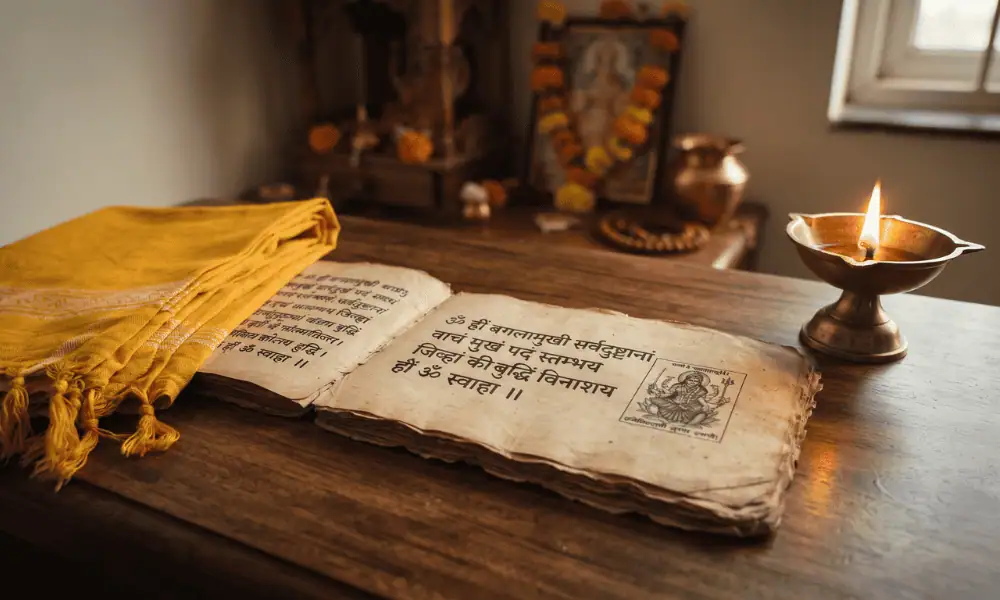
Maa Baglamukhi Mantra
Maa Baglamukhi Mantra in Hindi
Full Maa Baglamukhi Mantra
The traditional Maa Baglamukhi Mantra is:
ॐ ह्लीं बगलामुखी सर्व दुष्टानाम वाचं मुखं पदं स्तम्भय जिह्वां कीलय बुद्धिं विनाशय ह्लीं ॐ स्वाहा॥
Devotees traditionally approach this mantra with faith and respect as part of their worship and spiritual practice.
Maa Baglamukhi Mantra in English
English Transliteration
Om Hleem Baglamukhi Sarva Dushtanaam Vaacham Mukham Padam Stambhaya Jihvaam Keelaya Buddhim Vinashaya Hleem Om Swaha
Meaning of Maa Baglamukhi Mantra
The Maa Baglamukhi Mantra contains several phrases that are traditionally understood in relation to restraint, protection, stillness, and the control of harmful or disruptive influences.
Meaning of Om Hleem
Om is a sacred sound used in many Hindu spiritual practices.
Hleem is traditionally regarded as a seed syllable associated with Maa Baglamukhi. In devotional and esoteric interpretations, it is connected with her power of stillness, restraint, and stabilization.
Meaning of Baglamukhi
Baglamukhi is the divine name of Maa Baglamukhi, one of the Ten Mahavidyas.
The name is invoked as part of addressing and worshipping the Goddess.
Meaning of Sarva Dushtanaam
Sarva Dushtanaam can be understood as referring to harmful, hostile, or negative influences.
In spiritual interpretations, such influences may also be understood in relation to inner disturbances such as anger, confusion, harmful speech, and other obstacles.
Meaning of Vaacham Mukham Padam Stambhaya
This part of the mantra invokes the power to restrain speech, expression, and harmful activity.
The idea of Stambhana is traditionally associated with stilling or bringing disruptive activity to a halt.
Meaning of Jihvaam Keelaya
Jihvaam Keelaya refers traditionally to restraining or immobilizing the tongue.
In a devotional interpretation, this can be understood in relation to restraining harmful, false, harsh, or uncontrolled speech.
Meaning of Buddhim Vinashaya
Buddhim Vinashaya is traditionally interpreted in relation to removing or overcoming corrupted, confused, or harmful thought.
Rather than understanding this only externally, devotees may also contemplate the removal of inner confusion and destructive tendencies.
Meaning of Hleem Om Swaha
The mantra concludes with Hleem Om Swaha, traditional sacred syllables associated with the completion and offering of the mantra.

How to Chant Maa Baglamukhi Mantra
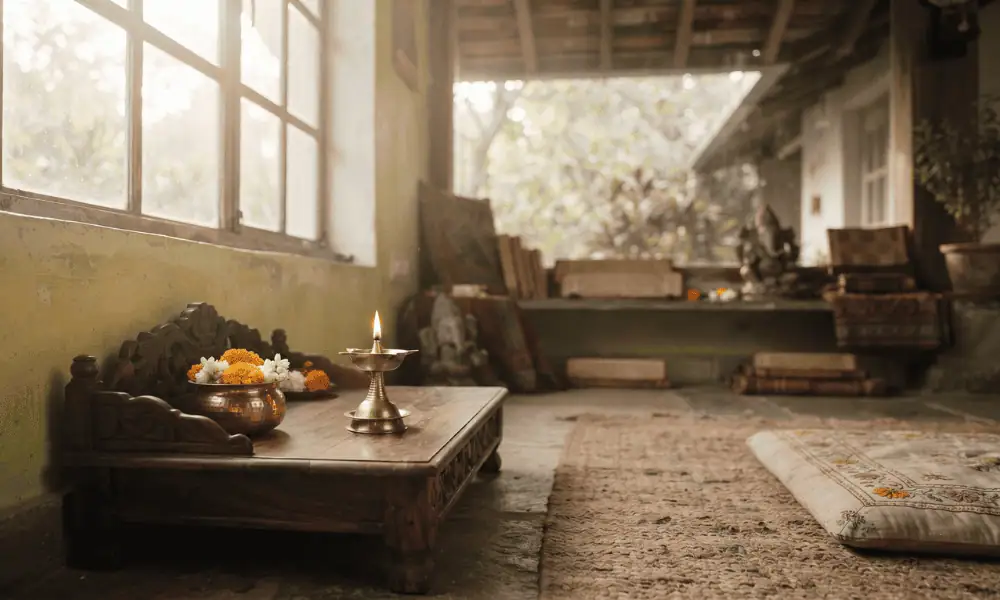
Maa Baglamukhi Mantra can be approached as a devotional practice with cleanliness, concentration, faith, and respect.
Prepare a Clean and Quiet Place
Choose a clean and peaceful place where you can sit without unnecessary disturbance.
If you have a dedicated prayer space, you may use it for your daily practice.
Sit Comfortably and Focus Your Mind
Sit comfortably and take a few moments to settle your mind before beginning.
The purpose is not to rush through a fixed number of repetitions but to maintain attention and devotion during the recitation.
Begin With a Prayer or Sankalp
Before chanting, you may offer a simple prayer to Maa Baglamukhi and state your sincere intention or Sankalp.
A personal Sankalp may be expressed in simple words according to your devotional tradition.
Recite the Mantra With Proper Pronunciation
Recite the mantra clearly and attentively.
If you are unfamiliar with the pronunciation, it is better to learn it carefully from a reliable traditional source or knowledgeable practitioner rather than repeatedly memorizing an incorrect pronunciation.
Complete Your Practice With Prayer
After completing your recitation, sit quietly for a moment and offer a final prayer to Maa Baglamukhi.
You may express gratitude and seek spiritual strength, clarity, protection, and guidance.
How Many Times Should You Chant Maa Baglamukhi Mantra?
There is no single number that applies universally to every devotee or every form of practice.
For simple devotional practice, many devotees use a mala of 108 repetitions as a traditional counting method.
The quality of attention, pronunciation, consistency, and devotion is more important than simply increasing the number of repetitions.
One Mala or 108 Repetitions
A mala traditionally contains 108 beads and can be used to keep count during mantra recitation.
Devotees who wish to establish a regular practice may choose one mala according to their personal tradition and comfort.
Regular Devotional Practice
For everyday devotional chanting, consistency can be more useful than attempting a very large number of repetitions occasionally.
A devotee may establish a simple routine that can be followed sincerely and respectfully.
What Does Hleem Mean in Maa Baglamukhi Mantra?
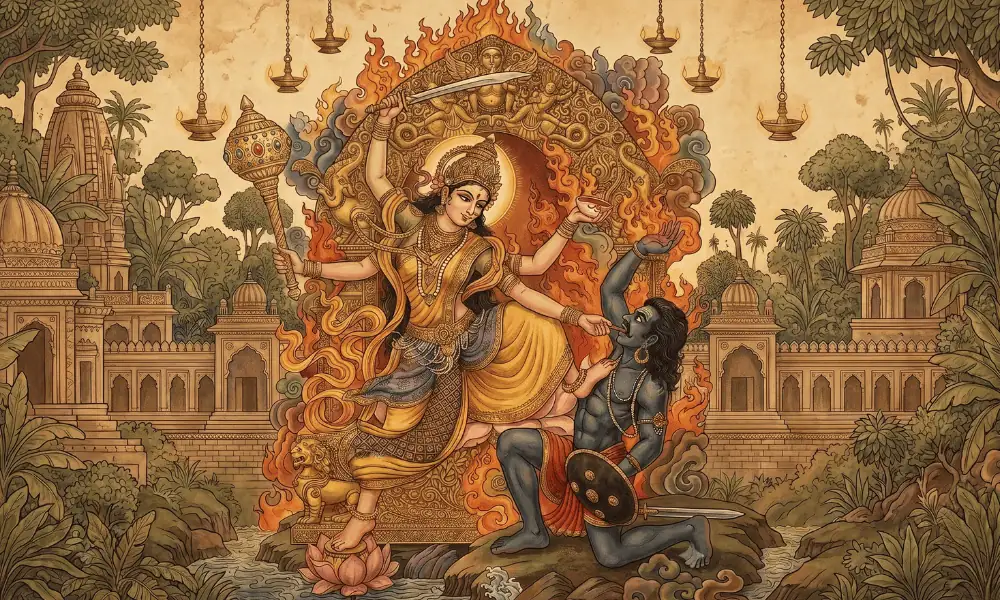
Hleem is traditionally regarded as the principal seed syllable associated with Maa Baglamukhi.
In traditional spiritual interpretations, it is associated with qualities such as stillness, restraint, concentration, and the ability to bring disruptive influences under control.
Because seed syllables have a deeper place in mantra traditions, their interpretation should not be reduced to a single literal English translation.
What Does Stambhana Mean?
Stambhana is a Sanskrit term associated with stopping, restraining, stilling, or bringing something to a standstill.
In Maa Baglamukhi worship, the concept is traditionally associated with the restraint of harmful speech, disruptive influences, reactive tendencies, and mental turbulence.
For devotional practice, it can also be contemplated as an invitation to develop greater inner steadiness and control over one’s own reactions.
Intensive Mantra Sadhana
Intensive mantra sadhana, prolonged practice, high repetition counts, or formal ritual observances are different from simple devotional chanting.
Such practices are traditionally undertaken according to a specific method or lineage and are better approached with guidance from a knowledgeable practitioner or teacher.

Can Beginners Chant Maa Baglamukhi Mantra?
Beginners can approach Maa Baglamukhi through simple devotional prayer and respectful mantra recitation.
If you are new to the mantra, begin with a manageable practice and focus on learning the pronunciation correctly.
There is no need to immediately undertake intensive sadhana or large repetition counts.
For more advanced or formal practices, traditional guidance can be valuable.
Is Diksha Required for Maa Baglamukhi Mantra?
Traditional views regarding Diksha can differ according to lineage and the type of practice being undertaken.
Simple devotional remembrance and prayer are approached differently from intensive mantra sadhana, formal ritual practice, or high-count spiritual disciplines.
If you are undertaking an intensive or formal Baglamukhi sadhana, it is best to follow the guidance of an appropriate traditional teacher or lineage.
Can You Chant Maa Baglamukhi Mantra at Home?
Yes, Maa Baglamukhi Mantra can be approached as part of personal devotional practice at home.
Choose a clean and peaceful space and maintain a respectful attitude during your practice.
You can also include mantra recitation as part of simple Maa Baglamukhi worship at home.
For a complete guide to preparing a home worship space and performing simple devotional worship, see our guide:
Worship Maa Baglamukhi at Home
Best Time and Place to Chant Maa Baglamukhi Mantra
A clean and peaceful environment can help you maintain concentration during mantra practice.
Many devotees prefer to establish a regular time for prayer so that the practice becomes consistent.
Rather than becoming overly concerned about finding a perfect time, beginners can focus on developing a sincere and disciplined devotional routine.
For formal sadhana, specific timings and procedures may depend on the tradition or lineage being followed.
What Should You Wear During Mantra Practice?
Clean and comfortable clothing is appropriate for simple devotional mantra practice.
Yellow is traditionally associated with Maa Baglamukhi, and devotees may choose yellow clothing or other traditional devotional elements according to their personal practice.
The most important aspect for ordinary devotional chanting is cleanliness, respect, and a focused mind.
Can Women Chant Maa Baglamukhi Mantra During Periods?
There is no single universal rule across all Hindu traditions regarding mantra recitation during menstruation.
Practices can differ between families, temples, lineages, and spiritual traditions.
For simple personal prayer and devotional remembrance, women may follow their own family or spiritual tradition and personal comfort.
For formal or intensive sadhana, it is best to follow the specific guidance of the tradition or teacher being followed.
Maa Baglamukhi Mantra for Specific Intentions
Devotees may approach Maa Baglamukhi through prayer with different personal intentions, such as seeking clarity, inner strength, protection, steadiness, or guidance during difficult circumstances.
The mantra should not be presented as a guaranteed method for controlling another person or obtaining a particular worldly outcome.
A sincere devotional approach focuses on one’s own conduct, prayer, discipline, and inner steadiness.
Mantra for Inner Stability and Focus
Maa Baglamukhi worship is traditionally associated with stillness and restraint.
Devotees may therefore use mantra practice as an opportunity to develop greater focus, calmness, and awareness of reactive thoughts and speech.
Mantra for Prayer and Spiritual Practice
The mantra may also form part of a wider devotional routine that includes prayer, meditation, Chalisa, Aarti, or other traditional forms of Maa Baglamukhi worship.
Maa Baglamukhi Mantra PDF
If you would like to keep the Maa Baglamukhi Mantra for personal devotional reading or offline reference, a PDF version can be provided here.
Maa Baglamukhi Mantra Benefits
Devotees traditionally recite Maa Baglamukhi Mantra as part of spiritual practice and prayer.
Depending on the individual’s devotional tradition, the practice may be associated with:
greater mental steadiness
focused attention
restraint of reactive speech
spiritual discipline
inner composure
prayer for protection and guidance
greater awareness of one’s thoughts and actions
These should be understood as traditional spiritual and devotional purposes rather than guaranteed worldly results.
Mantra practice is not a substitute for practical action, professional advice, or responsible decision-making in everyday life.
Are There Any Side Effects of Baglamukhi Mantra?
Questions about the possible side effects of Baglamukhi Mantra are common.
Simple devotional recitation should be approached with a calm and respectful mindset. Intensive mantra practices are different and may involve specific traditional rules, pronunciation, counts, rituals, or initiation depending on the lineage.
If you are beginning, there is no need to rush into complicated or high-count practices.
For intensive sadhana, it is appropriate to follow the guidance of an experienced and knowledgeable practitioner within a genuine traditional setting.
If mantra practice causes significant anxiety, distress, sleep disruption, or other concerning symptoms, pause the practice and seek appropriate help rather than assuming that such experiences are necessarily spiritual effects.
Maa Baglamukhi Mantra Lyrics
ॐ ह्लीं बगलामुखी सर्व दुष्टानाम वाचं मुखं पदं स्तम्भय जिह्वां कीलय बुद्धिं विनाशय ह्लीं ॐ स्वाहा॥
For devotional recitation, it is helpful to learn the pronunciation carefully rather than rushing through the words.
Om Hleem Baglamukhi Mantra
The phrase Om Hleem Baglamukhi is closely associated with Maa Baglamukhi mantra practice. The seed syllable Hleem is traditionally associated with Maa Baglamukhi and is an important part of her mantra tradition.
Om Hleem Baglamukhi Mantra in Hindi
ॐ ह्लीं बगलामुखी सर्व दुष्टानाम वाचं मुखं पदं स्तम्भय जिह्वां कीलय बुद्धिं विनाशय ह्लीं ॐ स्वाहा॥
Om Hleem Baglamukhi Mantra in English
Om Hleem Baglamukhi Sarva Dushtanaam Vaacham Mukham Padam Stambhaya Jihvaam Keelaya Buddhim Vinashaya Hleem Om Swaha
The mantra should be approached as a devotional practice rather than as a means of seeking harm or control over another person.
Baglamukhi Mantra - FAQ's
The Maa Baglamukhi Mantra is a traditional mantra associated with the worship of Maa Baglamukhi. It is recited by devotees as part of prayer and spiritual practice.
Om Hleem Baglamukhi is associated with Maa Baglamukhi’s mantra tradition, with Hleem serving as an important seed syllable in the mantra.
Yes. Simple devotional chanting can be incorporated into a regular personal prayer routine according to your tradition, comfort, and circumstances.
There is no single universal count for every devotee. A mala of 108 repetitions is a traditional counting method commonly used for mantra practice.
Yes. You can practice devotional mantra recitation at home in a clean and peaceful space.
Beginners can start with simple devotional recitation, focusing on pronunciation, attention, and consistency rather than immediately undertaking intensive practices.
Traditional views differ depending on the type of practice and lineage. Simple devotional prayer is different from intensive or formal mantra sadhana, for which traditional guidance may be appropriate.
Traditions differ. For simple devotional prayer, many people follow their own family or spiritual tradition and personal comfort. Formal sadhana should follow the guidance of the relevant tradition or teacher.
Stambhana is traditionally associated with stopping, restraining, or bringing something to stillness. In Baglamukhi worship, it can relate to the restraint of harmful speech, disruptive influences, and reactive tendencies.
Explore More About Maa Baglamukhi
-
Baglamukhi?
Explore Baglamukhi & her traditional worship -
Who Is Maa Baglamukhi?
Learn about her significance and traditional worship. -
Baglamukhi Puja
Explore traditional Puja and Havan. -
Baglamukhi Aarti
Read and learn about the traditional Baglamukhi Aarti. -
Baglamukhi Chalisa
Explore the Baglamukhi Chalisa and its devotional significance. -
Baglamukhi 108 Names
Explore the 108 names of Maa Baglamukhi -
Baglamukhi Stotram
Read the traditional Baglamukhi Stotram. -
Have another question about Baglamukhi worship or practice?
Explore the Baglamukhi FAQ